Ever wonder why you can’t get your grocery bill under control, but your next door neighbor, who has 6 kids, definitely can? It can be downright frustrating and discouraging to set a grocery budget of $500 only to go over that amount by $200 or even $500 every month. Read on to find out how you can determine the true amount your family should be spending on groceries each month. No more comparing yours to your neighbors, ‘ight? 🙂
When we first got married, we lived in a small college town and I was attending school while my husband was working. We made less than $1,500 per month, and I was absorbed in sticking to our $200 grocery budget every month. During the 9 months we lived there, we bought gummy bears twice, ice cream once, and rarely had any sides to go with our entrees at dinner. I don’t even remember eating snacks. Basically, we ate cereal and milk for breakfast, sandwiches for lunch, and boring and unhealthy dinners that didn’t really fill us up. My poor husband was probably starving!
The reason why I stuck to that budget so strictly was not just because of our income. It was also because I read somewhere that you should spend $100 per person on groceries. I didn’t even consider that maybe whoever wrote that had their own garden or used coupons.
Less Money Means Less Food?
This summer, my husband changed jobs and our income became slimmer than ever. I started to rethink what we were eating and if we should be eating rice and beans instead. Spending less on food when you make less money is what most people do, right?
After thinking more about it, I realized that no matter what your income is, you should be able to eat well. If you aren’t eating well, that means more sickness and more trips to the doctor’s office. I’d rather pay more for good, healthy food than more for healthcare and medicine.
You Can’t Compare Grocery Budgets
I often wonder why people are comparing grocery budgets when every family is completely different. Some families consist of two people and others ten. In the same breath, some families have special diet considerations, like gluten-free or dairy-free while others get take-out four times a week and eat convenience foods (cans, freezer meals, etc.) the rest of the time. Comparing grocery budgets just doesn’t make sense.
6 Steps to Determine Your Family’s Unique Grocery Budget
To come up with a food budget for your own family, go through the following steps to keep it realistic, realize your priorities, and understand why your budget will be so different from someone else’s. All of these factors will make a big impact on how much you spend every month.
1. EVALUATE YOUR FAMILY’S SITUATION
You have to consider your family’s current situation before you can come up with a budget. Take into account the following:
How many people are in your family?
How old are your kids? (toddlers might eat like birds, while teenagers could eat out your pantry!)
What is your income?
Where do you live?
What is your working situation? (commute, stay home, etc.)
Do you travel for work?
Are any of your kids in daycare, preschool, or school?
After answering these questions, you will better know the base of your grocery budget. If you make less money, you might consider trying to keep your grocery budget fairly low. If you live in a large metropolitan city, you might have to pay more for your groceries. Evaluating all these factors can help you get a better idea of the ballpark figure your budget should be in.
2. KNOW YOUR FAMILY’S HABITS
Habits can make or break a grocery budget. Answer these questions to find out how your family’s habits will play into your own budget:
How many meals do you eat?
What does your family like to eat for meals and snacks?
What do you do with leftovers?
Do you cook all your meals, some of them, or eat out a lot?
Do you make common items at home (such as bread, salad dressing, and chicken broth)?
Do you take lunch to work or buy lunch?
Are you a real food family or do you like pre-packaged foods that are highly convenient?
Is meat or produce the dominant food on your plates?
Are you going to buy produce in season or just whatever the recipe calls for?
How often do you eat dessert or make treats?
Do you shop grocery store sales?
Where do you shop most of the time?
When you know the general habits your family has with food, it will be easier to see why you might be spending less or more. Some habits will increase your budget and others will actually lower it.
3. CONSIDER SPECIAL CIRCUMSTANCES
Every family has special circumstances. Your budget may fluctuate from month to month based on some of these. Others are just a necessary part of your budget every month. Ask these questions to find out what your special circumstances might be:
Do you have a garden that you can rely on for part of the year?
Does anyone in your family have diet restrictions (vegan, gluten-free, etc.)?
Is there a baby in the house who needs formula and/or baby food?
Is anybody in your family sick?
What season is it? Are there any holidays or birthdays that you have to cook for?
Are you going to a potluck this weekend? Do you have friends that come over once a month for dinner and games?
Are you going on any trips or vacations?
Because your budget could fluctuate a lot based on the answers to the questions above, you may consider budgeting for the entire year instead of monthly, which I had never thought about until I read Build a Budget that Works. If you have a yearly grocery budget, you can set your grocery budget higher in some months than others.
For example, if you budget $4,800 for the year (that’s $400 per month), some months, like February, might be just $300 (since it has less days), and other months, like November, might be $500 (due to Thanksgiving).
4. ADD IN EXTRAS
Grocery shopping isn’t just about what you are going to eat right now. Sometimes you have to replace items in your pantry or make a meal for an ill friend. These kinds of costs can make your budget fluctuate for better or worse. Here are some questions to consider that will likely increase your budget:
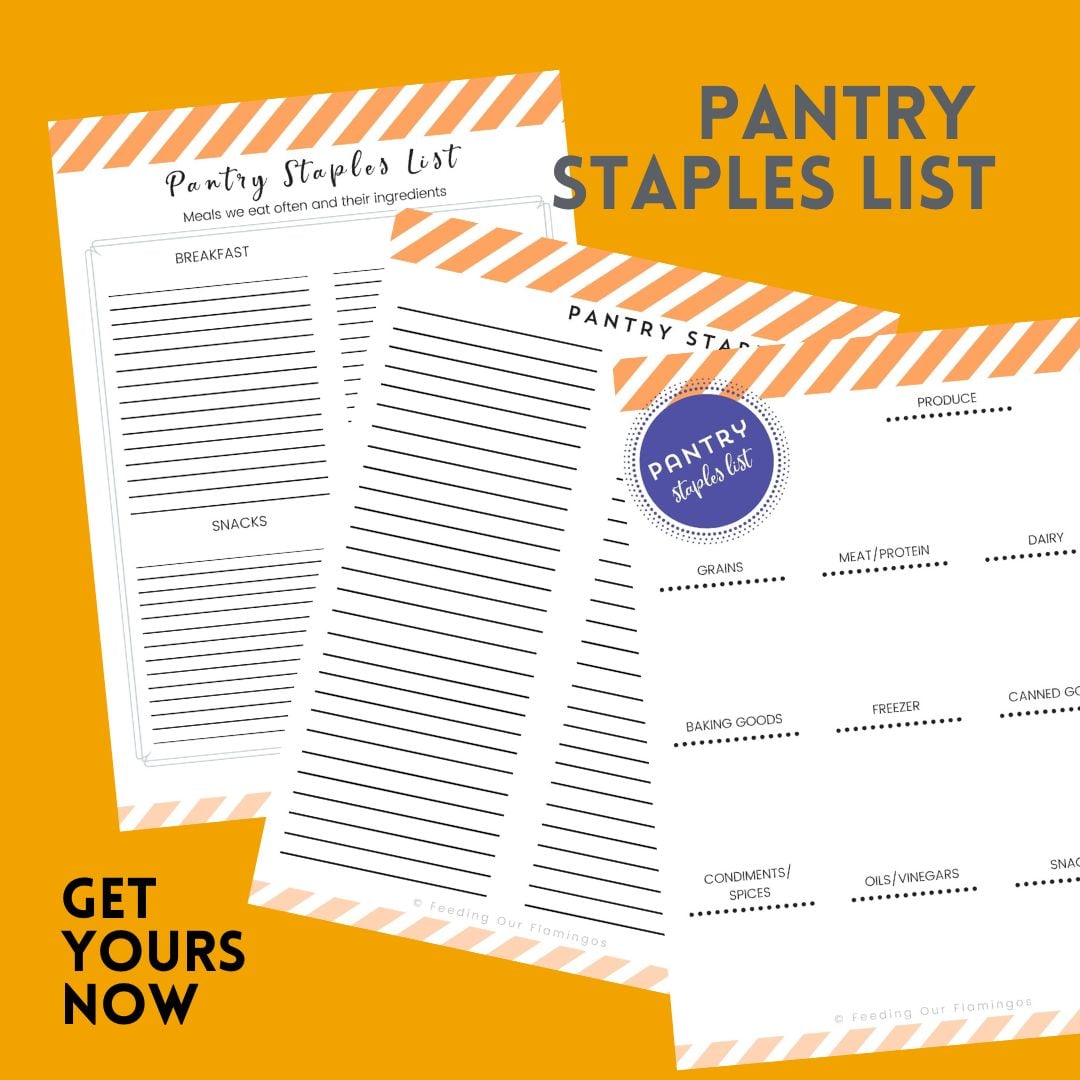
Do you need to replace any pantry staples, such as Mayo, salt, oil, or spices?
Do you need to get items to keep on hand so you can make a meal on the fly if necessary?
Are other goods (like paper towels, diapers, and plastic cups) part of your grocery budget or do they come out of a different category?
Do you buy food on sale to save for the future?
How often do you go out for a date or as a family?
By honestly answering these questions, you might discover that your budget cannot be as low as you’ve always had it, and that is why you spend more a lot of the time.
5. DECIDE HOW MUCH TIME YOU WANT TO SPEND
You can’t just put a number on paper and expect it to work. You have to put time and effort into the process (meal planning, cooking, shopping, etc.) if you want to stay within your budget. Go through the following questions to find out if you’re willing to spend more time to lower your grocery bill:
Do you coupon?
Do you use a meal planning service to cut out the meal planning process?
How often do you go grocery shopping? Twice a week, twice a month, once a month?
Are you cooking from scratch or opening cans and throwing frozen pizza in the oven?
Do you need to make freezer meals once a month for nights when you are too busy to cook?
Once you know what you will or won’t do to lower your grocery budget, you can pretty much figure out how much you should be spending each month.
6. PUT YOUR BUDGET TO THE TEST
Once you have discovered your ideal grocery budget amount, see if you can keep to it for a few months. If it seems like you are always going over or even under, you might need to adjust it.
Can you realistically stick to a low budget, or does your family’s situation, circumstances, and habits make that impossible?
What is your ideal grocery budget, after all the above questions have been considered?
As you can see, there are so many factors going into your grocery budget that you just can’t compare yours to anyone else’s. Make your grocery budget work for you and your family, and you won’t feel guilty if you have to adjust it.
What normally makes your own grocery budget stay under or go over each month?
About Charlee
I used to struggle big time with getting veggies into my family’s meals. After several years and much trial and error, though, I now believe you can cook healthy food and still have time for your loved ones.
This is great, very helpful advice. A grocery budget is a very unique budget item. I learned that after giving advice to my mom who’s grocery budget is explosive compared to mine. Their family structure is different.
Thank you, Patricia. It’s definitely not a one size fits all. I appreciate the visit!
E
Erin
I so appreciate your attention to detail. We are on a very tight budget as well. Yesterday I bought five turkeys. Five. Why? Because they are 88 cents/lb. and will last for a long time in the freezer! It will save us so much money in the upcoming months, even if we are sick of eating turkey. Stocking up on sales is something I’ve learned to do. I had a grocery cart full of 48 cent pasta the other day. I love finding a good deal, sticking close to the budget and still eating well!
I am actually terrible at stocking up. This post was pretty much for me. Haha. I could definitely learn a thing or two from the way you spend your money, Erin. Thanks for the feedback. I hope your turkeys taste wonderful every time!
PANTRY STAPLES. This is so important and I feel like it’s the easiest part of a grocery budget to miss! When you HAVE flour you think it will just always BE there somehow. So silly! Thank you so much for the excellent tips- especially as we enter this ingredient heavy season!
I KNOW, right! I hate it when we get to the bottom of the flour, cuz then I’ve gotta figure that we’re not going to spend $60 this week, but more like $68. It’s pretty depressing. Haha. I truly appreciate your feedback, Carla!
H
Hannah
I bake sourdough bread about 2 times a week and also bake goodies fairly often! I buy my flour bulk! 50lb for just $20! I HATE having to buy flour in the regular grocery store!! I have a big clear tote with a snap on lid for the flour and it saves SO much money and hassle!
Great post about determining your own unique personal grocery budget. This is important I always say a family budget should reflect the family not everyone.
Hey, what’s wrong with rice and beans? That’s totally nutritious and super cheap and gluten free 😉 We also make everything from scratch. We make our own granola, bread, yogurt, and eat less meat overall. Beans are a perfect example of saving money. We buy dry beans. For one bag of beans you can equal to about 5 cans of beans. It’s 5 x cheaper. I definitely think every family is different, but if you are truly looking to save money I think there are some practical go-to ways to accomplish that. Thanks for sharing. Pinning now 🙂
Honestly, I love using beans. It’s my husband that’s not a huge fan of them. He actually likes when I make refried beans, but when they are in their whole form, he doesn’t like the texture. Thanks for the input and for sharing, Lauren. 🙂
MI
Mama instincts
This is a great post! This is how a grocery budget should be made!
This is seriously one of your most thorough posts ever. You should have your own editorial section on CNN Money. I’m not kidding, seriously, submit this post somewhere!
I forget who it was but there was a financial blogger that wrote about how she got out of debt in the first three years of marriage and now she writes part time for forbes, basically just contributing posts she would’ve posted on her own blog. And your budget posts are DEFINITELY on that level. I hope you do look into it!
I appreciate this so much! We have purposefully made our grocery budget a large percentage of our overall budget, and it drives me nuts when articles advocate every one on the planet eating “cheap yet healthy”. I Read a statistic somewhere that said that Americans spend less for food than many comparable countries. I can see how it’s true. So many families are incredibly indebted and don’t see any alternative other than squeezing their food budget. This has allowed for cheap, unhealthy food to permeate our culture. I think there’s change afoot, though, a movement towards quality food. That combined with folks waking up to the dangers of debt, and I think there are some awesome times ahead! Off soapbox now 🙂
I’m glad to hear this topic resonates with you, too! I do believe there are times when you should try to lower your grocery budget (which takes effort on your part), but if you are able to pay all your bills and still have money left at the end of the month, there is no harm in spending a little more for healthy food. My husband’s family must have spent a lot on food because they used to have a BBQ every Saturday. I’m talking steaks, ribs, chicken, sausage, etc! He claims that beef was really cheap when he was growing up in Argentina, but it still seems like it would be expensive to do it on a weekly basis!
Hey, Argentinian cowboy life is one of the main things I remember about studying Argentina as a kid. I can’t tell you how many times I wish we knew a beef rancher well. We’re going to try to buy a side of beef this year if we don’t get much game for the freezer. I’m pretty sure it’s going to cost an arm and a leg!
That would be amazing to know a beef rancher. We plan to buy a cow one day, but we first need a much bigger freezer. My parents have one, but I don’t think it’s worth the 1 hour round-trip drive to go get meat for the week! It will definitely take a large chunk of cash out of our grocery budget each month, but I think it will be totally worth it. Sounds like you guys hunt?
I love this, thank you. We all struggle with this from time to time. A stockpile can also spend more money than normally if you’re not careful…and we have to rotate! <3









This is great, very helpful advice. A grocery budget is a very unique budget item. I learned that after giving advice to my mom who’s grocery budget is explosive compared to mine. Their family structure is different.
Thank you, Patricia. It’s definitely not a one size fits all. I appreciate the visit!
I so appreciate your attention to detail. We are on a very tight budget as well. Yesterday I bought five turkeys. Five. Why? Because they are 88 cents/lb. and will last for a long time in the freezer! It will save us so much money in the upcoming months, even if we are sick of eating turkey. Stocking up on sales is something I’ve learned to do. I had a grocery cart full of 48 cent pasta the other day. I love finding a good deal, sticking close to the budget and still eating well!
I am actually terrible at stocking up. This post was pretty much for me. Haha. I could definitely learn a thing or two from the way you spend your money, Erin. Thanks for the feedback. I hope your turkeys taste wonderful every time!
PANTRY STAPLES. This is so important and I feel like it’s the easiest part of a grocery budget to miss! When you HAVE flour you think it will just always BE there somehow. So silly! Thank you so much for the excellent tips- especially as we enter this ingredient heavy season!
I KNOW, right! I hate it when we get to the bottom of the flour, cuz then I’ve gotta figure that we’re not going to spend $60 this week, but more like $68. It’s pretty depressing. Haha. I truly appreciate your feedback, Carla!
I bake sourdough bread about 2 times a week and also bake goodies fairly often! I buy my flour bulk! 50lb for just $20! I HATE having to buy flour in the regular grocery store!! I have a big clear tote with a snap on lid for the flour and it saves SO much money and hassle!
Great post about determining your own unique personal grocery budget. This is important I always say a family budget should reflect the family not everyone.
Thank you, Britnee! I agree!
Hey, what’s wrong with rice and beans? That’s totally nutritious and super cheap and gluten free 😉 We also make everything from scratch. We make our own granola, bread, yogurt, and eat less meat overall. Beans are a perfect example of saving money. We buy dry beans. For one bag of beans you can equal to about 5 cans of beans. It’s 5 x cheaper. I definitely think every family is different, but if you are truly looking to save money I think there are some practical go-to ways to accomplish that. Thanks for sharing. Pinning now 🙂
Lauren
Honestly, I love using beans. It’s my husband that’s not a huge fan of them. He actually likes when I make refried beans, but when they are in their whole form, he doesn’t like the texture. Thanks for the input and for sharing, Lauren. 🙂